

Table of Contents
- What a Fragrance Concierge Actually Does
- How to Find Your Signature Scent With Expert Guidance
- Fragrance Wardrobe Building Made Simple
- Perfume Sampling Strategies That Actually Save Money
- The Psychology of Scent and Personal Expression
- Concierge vs. Self-Selection vs. AI Recommendations
- Sustainability and Transparency in Curated Fragrance
- Conclusion
- Frequently Asked Questions
Last Updated: September 23, 2026
What a Fragrance Concierge Actually Does
A fragrance concierge is a specialized expert who guides you through discovering, selecting, and building a personalized scent collection. Unlike browsing a department store counter alone, a concierge understands your olfactory preferences and curates recommendations that match who you are.
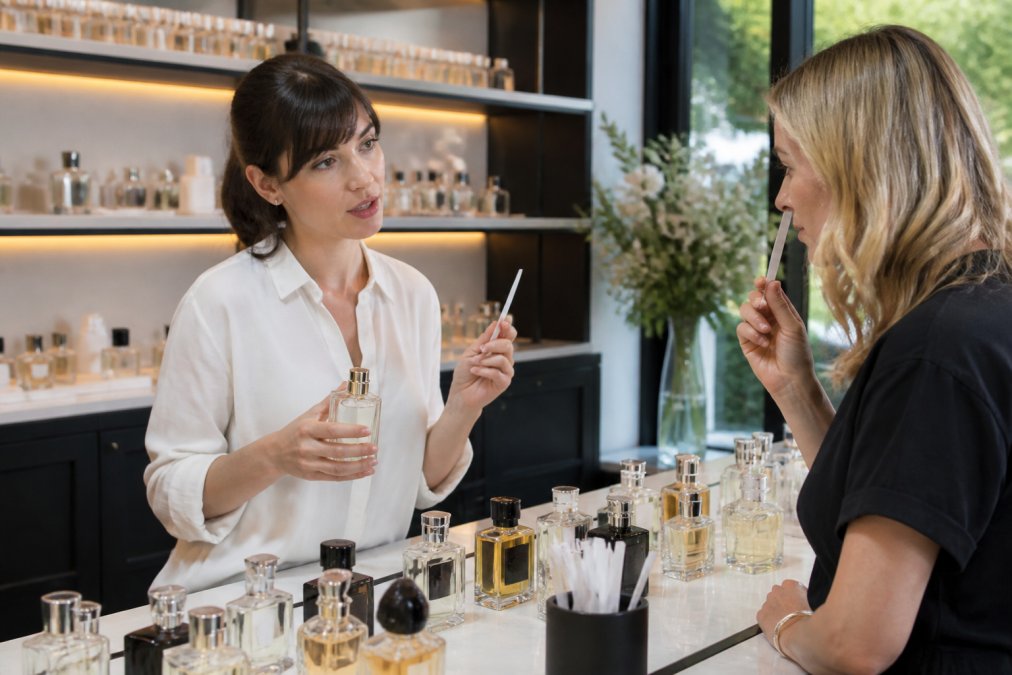
A concierge analyzes your scent profile by asking targeted questions about the notes you gravitate toward, the moods you want to evoke, and how fragrance fits your daily life. They understand fragrance families, florals, orientals, fresh, woody, and map your preferences across these categories. At Olfactory Outlaws, our concierge service combines personalized consultation with access to niche and emerging fragrance houses.
A proper olfactory journey with a concierge takes weeks or months, involving sampling, reflection, and refinement. You test decants and learn what works for you, eliminating the guesswork that leads to expensive mistakes.
How to Find Your Signature Scent With Expert Guidance
Finding a signature scent is a structured process: assessment, sampling, testing, and refinement.
In assessment, you discuss your scent history, personality traits, and lifestyle. A concierge asks whether you work in a corporate office, creative studio, or outdoor environment, and whether you prefer bold statements or subtle sophistication. These answers shape the recommendation strategy.
Strategic sampling follows: a concierge creates curated decants that test specific hypotheses about your preferences. If you love warm vanilla but dislike overly sweet scents, they might send three vanilla fragrances with varying depths. This targeted approach saves money while accelerating discovery.
Testing requires wearing each scent for at least three days. Your skin chemistry interacts with the fragrance, the scent evolves over hours, and your perception shifts with repeated exposure. A concierge helps you distinguish between "initial attraction" and "genuine compatibility."
You'll identify a signature scent, or more likely, two or three that serve different contexts, your olfactory signature.
Fragrance Wardrobe Building Made Simple
A fragrance wardrobe typically includes a fresh scent for daily wear, something richer for evenings, and a statement fragrance for special occasions, just as you vary your clothing.
A concierge structures your collection intelligently, understanding scent intensity, longevity, and seasonal appropriateness. A light citrus fragrance works for summer mornings but feels thin in winter; a deep amber overwhelms in summer but shines in autumn.
Start with one versatile scent you'll wear multiple times per week. Add complementary fragrances, if your signature is floral, add a woody or fresh option. This creates contrast and prevents olfactory fatigue.
Decants from services like Olfactory Outlaws make wardrobe building affordable. A concierge helps you prioritize which full bottles are worth the investment and which remain better as decants.
Perfume Sampling Strategies That Actually Save Money
The biggest financial mistake is buying full bottles without proper testing. Buying three wrong bottles represents significant wasted spending.
Strategic sampling flips this equation. Decants (2-5ml samples) cost a fraction of full bottles. A concierge uses sampling as a discovery tool, enabling systematic testing instead of blind purchases.
One effective strategy is the "themed sampling approach": three fragrances from the same scent family so you can compare how different perfumers interpret florals, teaching your nose what you prefer within a category.
Seasonal sampling prevents buying a winter fragrance in June that seemed perfect in summer but feels wrong when temperatures drop.
Time-based sampling reveals performance differences before you commit. You discover which fragrances last eight hours on your skin and which fade after three, critical information for purchase decisions.
Strategic decant spending prevents larger spending on wrong full bottles, leading to fewer, better full-bottle purchases and higher satisfaction.
The Psychology of Scent and Personal Expression
Fragrance is a neurobiological tool that shapes how you feel, how you remember, and how others perceive you, explaining why expert curation outperforms self-selection.
The Neuroscience Behind Scent Memory and Decision-Making
When you smell a fragrance, odorant molecules bind to receptors in your nasal epithelium, sending signals directly to your olfactory bulb. Unlike vision or hearing, smell bypasses the thalamus and connects immediately to the piriform cortex, amygdala, and hippocampus, the brain regions governing emotion, memory, and decision-making.
This direct pathway means fragrance triggers emotional and memory responses before conscious thought. A scent from a formative period can instantly recreate the associated emotional state, olfactory-evoked autobiographical memory. Functional MRI studies show olfactory stimuli activate the amygdala and hippocampus more directly than visual or auditory stimuli.
When you browse fragrances alone, your brain floods with limbic responses, attraction, aversion, memory triggers, without cognitive framework to distinguish genuine compatibility from emotional manipulation. A concierge interrupts this by asking why you're drawn to a scent, engaging your prefrontal cortex and creating distance between impulse and choice. This produces better long-term satisfaction because you're buying based on reasoned preference, not limbic hijacking.
Scent Chemistry and Skin Compatibility
Fragrance perception is highly individual because of skin chemistry. Your skin's pH, microbiome, natural oils, and diet influence how fragrance molecules interact. A fragrance that smells beautiful on one person can smell entirely different on another, why department store testers often disappoint at home.
A concierge has you test fragrances on your own skin over multiple days. Top notes (5-15 minutes) are largely fragrance-determined, but heart notes (15 minutes to 2 hours) and base notes (2+ hours) are heavily influenced by your skin chemistry. They guide you through this evolution, helping you distinguish between "initial attraction" and "genuine skin compatibility."
Fragrance as Identity Expression and Social Signaling
Fragrance communicates identity. A fresh, citrus-forward fragrance suggests energy and approachability. A deep, woody scent signals sophistication. A floral conveys elegance. An unconventional, niche fragrance says you value individuality.
These associations are culturally shaped but consistent enough that fragrance choice functions as non-verbal communication. A concierge helps you choose fragrances that align with your intended self-presentation, recognizing that fragrance selection is identity curation.
The olfactory journey becomes self-discovery. Testing fragrances reveals what you're drawn to and why, reflecting deeper aspects of your personality and values. A fragrance concierge guides this exploration with scientific understanding and psychological insight, producing a collection that feels authentically you.
Concierge vs. Self-Selection vs. AI Recommendations
Self-Selection: Autonomy at the Cost of Expertise
Self-selection works only with substantial time and budget for trial-and-error. Most self-selecting buyers purchase full bottles before finding one they love, representing significant wasted spending. You're susceptible to marketing hype and lack expertise to evaluate longevity, skin chemistry interaction, or seasonal performance. You're also limited to fragrances stocked by major retailers, missing niche and artisanal houses.
Self-selection makes sense for a single gift or first-time testing. It doesn't work for building a collection or with specific preferences.
AI Recommendation Systems: Speed Without Understanding
AI tools analyze your preferences, browsing history, and purchase data to suggest fragrances algorithmically. AI tools analyze your preferences, browsing history, and purchase data to suggest fragrances algorithmically.
AI offers speed and scale, processing thousands of profiles instantly to find fragrances with similar note structures.
AI lacks sensory understanding. It cannot account for how a fragrance performs on your skin chemistry, how your perception evolves after a week, or how it fits your lifestyle. An algorithm might recommend a fragrance with similar notes to one you loved, but if the base note performs differently on your skin or longevity is half as long, the recommendation fails.
AI cannot navigate subjective dimensions: whether you want to project confidence or approachability, whether you're drawn to fragrances that evoke memory, or whether you prioritize sustainability. These are human values, not data patterns.
AI recommendations work best as a starting point to narrow options, not as a replacement for expert judgment.
Human Concierge: Expertise, Personalization, and Curation
A human concierge combines olfactory expertise, psychological insight, and personalized guidance. They understand fragrance chemistry, scent families, performance characteristics, and the psychology of scent selection.
Choosing Your Path
Sustainability and Transparency in Curated Fragrance
Fragrance sustainability matters more as the industry matures. Concerns about ingredient sourcing, environmental impact, and ethical production are legitimate.
Conclusion
A fragrance concierge transforms scent discovery from a frustrating guessing game into a guided, strategic process. You get expert guidance, access to niche fragrances most retailers don't carry, and a personalized approach to building a collection that genuinely reflects who you are. Rather than spending money on wrong full bottles, you invest in sampling and curation, and end up with fragrances you'll actually wear and love.
Frequently Asked Questions
What does a fragrance concierge do?
A fragrance concierge provides personalized scent recommendations based on your preferences, personality, and lifestyle. They assess your olfactory profile through consultation, guide you through niche and designer options, help you build a fragrance wardrobe, and often provide sampling strategies to minimize cost while maximizing discovery. Expert concierges understand fragrance notes, intensity levels, and how scents interact with body chemistry to match you with your signature scent.
Is a fragrance concierge service worth the investment?
Yes, especially if you're building a collection or seeking rare niche fragrances. A concierge saves time by eliminating guesswork and provides access to exclusive fragrance houses and emerging releases. For fragrance enthusiasts and collectors, the personalized guidance and curation justify the service cost, particularly when combined with sampling strategies that let you test before committing to full-bottle purchases.
How can a fragrance concierge help me find a signature scent?
A concierge uses scent assessment techniques to understand your personality, mood preferences, and lifestyle to create your olfactory profile. They consider factors like your favorite fragrance notes, scent intensity preferences, and how you want to be perceived. Through guided sampling and expert consultation, they narrow down options and help you discover a scent that becomes uniquely yours, one that aligns with your personal branding and sensorial preferences.
How does a fragrance concierge help with gift-giving?
A concierge gathers information about the recipient's scent preferences, lifestyle, and personality to recommend a fragrance that feels personal and thoughtful. They can suggest niche or designer options aligned with the recipient's taste, help you understand fragrance families and intensity levels, and sometimes provide sampling options so you can test the scent before purchasing a full bottle. This expert guidance removes the guesswork from fragrance gifting.
| Approach | Time Investment | Cost | Expertise | Accuracy |
|---|---|---|---|---|
| Self-Selection | High (trial-and-error) | Variable (expensive mistakes) | None | Low |
| AI Recommendations | Low | Low-Moderate | Algorithmic only | Moderate |
| Fragrance Concierge | Moderate (structured process) | Moderate (prevents waste) | Expert-guided | High |