

Table of Contents
- How Long Do Fragrance Decants Last? The Short Answer
- How Long Does a 10ml Decant Last?
- Factors That Affect Fragrance Decant Shelf Life
- Best Way to Store Perfume Decants
- Glass vs Plastic Atomizers for Perfume Decants
- How to Spot Spoilage: Oxidation and Evaporation Signs
- How to Make Fragrance Decants Last Longer
- Frequently Asked Questions
Last Updated: September 14, 2026
How Long Do Fragrance Decants Last? The Short Answer
A fragrance decant typically stays true to its original scent for one to three years when stored properly in glass with an airtight seal (pubmed.ncbi.nlm.nih.gov). In practice, most land closer to 12-18 months if they sit on a sunny dresser or ride around in a hot car. This guide from Olfactory Outlaws breaks down what shortens that window, how to spot a decant that has turned, and the storage habits that keep a fragrance decant smelling like the day it was poured.
The single biggest variable is not the juice itself. It is the container and where you keep it.
Fragrance decants are small portions of a full bottle transferred into a travel-size vial or atomizer, usually 2ml to 10ml, so you can test a scent before committing to a full bottle. Because a decant exposes the fragrance to a new container and headspace, its shelf life depends on how well that container seals and how much light and heat reach it.
Below: realistic timelines, the factors that speed up degradation, and a storage protocol you can set up in ten minutes.
How Long Does a 10ml Decant Last?
A 10ml decant lasts roughly 12 to 24 months in storage, but the more useful question is how long it lasts once you start wearing it. At two sprays per day, a 10ml bottle runs out in about five to six weeks.
Sprays Per Day and Bottle Duration
Daily wear habits decide whether a decant is a month-long companion or a two-year resident of your drawer. The practical math:
| Sprays Per Day | 2ml Decant | 5ml Decant | 10ml Decant |
|---|---|---|---|
| 1 spray | ~4 weeks | ~10 weeks | ~20 weeks |
| 2 sprays | ~2 weeks | ~5 weeks | ~10 weeks |
| 4 sprays | ~1 week | ~2.5 weeks | ~5 weeks |
These estimates assume a standard atomizer delivering about 0.1ml per spray (pubmed.ncbi.nlm.nih.gov). Heavier sprayers and wide-cone nozzles drain a vial faster.
Decant Size vs. Usage Duration
Smaller decants finish before they have time to degrade, which is why sampling sizes are the safest format for long-term collection building. A 2ml vial you spray daily empties long before oxidation becomes a concern, while a 10ml decant used twice a month sits half-full for a year, and that lingering air gap is where spoilage starts.
Factors That Affect Fragrance Decant Shelf Life
Three forces drive most decant degradation: light, heat, and oxygen. How fast they win depends heavily on what is inside the vial, two decants stored side by side in the same drawer can age at completely different rates because their chemical makeup differs.
Why Fragrance Families Age at Different Rates
A fragrance is a blend of volatile aromatic molecules, and they do not all resist breakdown equally, molecular structure decides how quickly oxygen and ultraviolet light can pull them apart.
Citrus and aromatic top notes are the fragile ones. Materials built on limonene, linalool, and similar terpenes, the compounds behind bergamot, lemon, orange, and lavender, are small, reactive molecules with double bonds oxygen attacks readily (pubmed.ncbi.nlm.nih.gov). That is why a bright citrus opening is usually the first thing to go flat or turn sharp in an aging decant; a classic cologne or fresh summer scent can shift noticeably in months rather than years.
Woody, resinous, and oriental bases are the durable ones. Molecules like sandalwood's santalol, patchouli's patchoulol, and the resinous materials in amber and incense accords are larger, more stable, and slower to oxidize. A decant built around oud, vetiver, or a heavy amber base often smells close to new well past the point where a citrus-forward vial has turned.
Aldehydes and some florals sit in the middle, more stable than citrus, more reactive than woods, so a soapy aldehyde-heavy scent or delicate white floral may lose its sparkle before a chypre or oriental does.
The practical takeaway: for long-haul storage, expect fresh and citrus-forward samples to have the shortest useful window and deep, resinous ones the longest. Rotate the fragile ones to the front of your queue.
Light Exposure and Temperature Fluctuations
Ultraviolet light breaks down aromatic compounds, and heat accelerates the reaction. A decant on a windowsill can shift noticeably within weeks, while the same decant in a closed drawer holds its scent profile for a year or more.
Temperature swings matter as much as absolute heat. A bathroom shelf that warms up every morning shower creates constant expansion and contraction inside the vial, pushing vapor past the seal and pulling fresh air in, every cycle introduces new oxygen to the juice.
Oxygen, Headspace, and Alcohol Content
Oxygen is the slowest-acting of the three forces but the hardest to avoid, because every spray lets air replace the liquid you removed. The larger the air gap, the more surface area the fragrance exposes to oxygen, and the faster oxidation proceeds.
Alcohol content cuts both ways: the carrier evaporates faster than the oils, so a decant left open or loosely sealed loses volume and concentrates its remaining materials, distorting the scent. A tight seal is the only real defense, and it is worth testing rather than assuming.
Best Way to Store Perfume Decants
The best way to store perfume decants is upright, in glass, in a cool dark place with a stable temperature, ideally between 55°F and 70°F. Keep them out of bathrooms and away from windows.
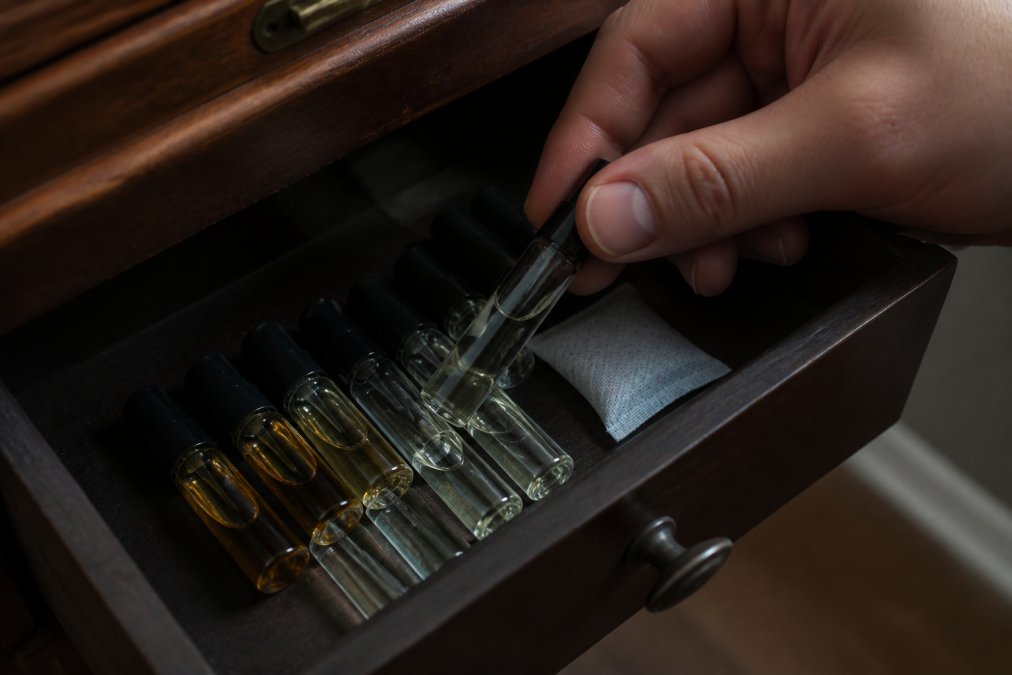
A simple storage setup covers almost every risk:
- A closed wooden box or drawer that blocks light completely
- A location away from radiators, vents, and direct sun
- Vials kept upright so liquid never pools against the seal
- A silica packet in the box to absorb ambient moisture
- Labels with the fill date so you rotate older decants first
What most guides miss is the rotation habit. Treat your decant box like a pantry: use the oldest first, and you will rarely pour a turned vial.
Glass vs Plastic Atomizers for Perfume Decants
Glass atomizers win for anything you plan to keep longer than a few weeks. Plastic is fine for short-term travel but the wrong choice for storage.
Plastic is permeable at a microscopic level: fragrance molecules migrate through the wall and escape, and plasticizers can leach into the juice and alter the scent. Glass is chemically inert, so it neither absorbs nor releases anything into the fragrance.
The trade-off is fragility and cost. Glass vials break if dropped and usually cost more, but for a decant you intend to keep for months, glass with a tight screw cap or crimped atomizer is the only format worth trusting.
How to Spot Spoilage: Oxidation and Evaporation Signs
Oxidation and evaporation are the two failure modes to watch for, and they show up differently. Oxidation changes how a decant smells, while evaporation changes how much is left and concentrates what remains.
Signs a decant has turned:
- A sharp, sour, or vinegar-like note that was not there before
- The opening smells harsh while the dry-down seems flat or missing
- Visible darkening of the liquid compared to a fresh pour
- A thin, watery texture where the fragrance used to feel rich
- Liquid level dropping faster than your usage explains
How to Identify Oxidized Perfume
To identify oxidized perfume, compare the suspect decant against a fresh sample of the same scent, ideally side by side on skin. Oxidized fragrance loses its top notes first, so the bright opening collapses while the base may still read normally.
A common mistake is blaming a fragrance for "not lasting" when the real issue is a degraded decant. If a scent you loved turns sharp or hollow, test a fresh pour before writing off the fragrance itself.
How to Make Fragrance Decants Last Longer
Extending a decant's life comes down to a handful of habits, none requiring special equipment. The two that matter most, testing your seal and knowing when a turned decant is worth saving, are the ones most guides skip.
- Transfer to a glass vial with an airtight seal as soon as possible
- Store upright in a cool, dark place at a steady temperature
- Minimize headspace by choosing a vial size that matches your usage
- Keep the cap on between uses and avoid leaving the atomizer open
- Label each decant with its fill date and rotate oldest-first
How to Test Whether a Decant Vial Is Actually Airtight
A seal that looks fine can still leak vapor, and a leaking seal is the number one cause of a decant disappearing faster than you can wear it. Test it before you trust it.
The inversion test. Fill the vial, cap or crimp it tightly, then turn it upside down over a paper towel for a full minute. Any moisture ring, damp spot, or visible seepage means the seal is failing. A properly sealed vial stays bone dry.
The weight test. Weigh a filled vial on a kitchen scale accurate to 0.1 grams, note the number, and weigh it again after a week without spraying. A drop of more than a fraction of a gram means vapor is escaping even though no liquid is visible.
The nose test. Store the vial in a closed box with a scrap of unscented paper for a few days. If the paper picks up the fragrance, the seal is venting scent into the box instead of keeping it in the vial.
The sprayer test. For atomizer decants, the crimp or screw collar is a common failure point. Press the collar gently and check for any give. A loose collar leaks around the stem no matter how tight the cap feels.
If a vial fails any of these, do not just tighten the cap and hope. Transfer the juice to a fresh glass vial with a new seal, or wrap the threads with a thin strip of plumber's tape as a stopgap. A failing seal will not fix itself, and every day it leaks shortens the decant's life.
Can a Turned Decant Be Saved?
This is the question most people actually want answered, and the honest answer depends on what went wrong.
If the problem is evaporation, yes. A decant that has lost volume but still smells correct is simply more concentrated. Top it off with a small amount of perfumer's alcohol to restore the original dilution, or wear it as-is and accept it will project a little differently. Nothing has spoiled.
If the problem is oxidation, usually no. Once aromatic molecules break down, they cannot be reassembled, you cannot un-oxidize a fragrance. That said, a mildly oxidized decant is sometimes still wearable: the collapsed top notes may be gone, but the base can remain pleasant. Try it on skin before discarding it; if the opening is harsh but the dry-down is fine, you may still enjoy it as a base-forward scent.
If the problem is contamination, discard it. A decant that smells sour, vinegary, or moldy, or shows floating particles or new cloudiness, has likely been contaminated by a dirty pipette, funnel, or poorly cleaned vial. There is no safe way to recover it.
A useful rule of thumb: sharp or chemical means oxidation and it is gone; musty or off means contamination and it is gone. If it just smells weaker or flatter than you remember, compare it against a fresh sample before throwing it out, you may be remembering the top notes, which fade first in every decant regardless of storage.
The Sustainability Angle
Disposable plastic sampler vials generate steady waste, and reusable glass decants you refill cut that significantly while protecting the fragrance better. For collectors building a rotation over years, reusable glass is both the greener and the smarter choice.
Frequently Asked Questions
Does decanting a fragrance ruin it?
Decanting itself does not ruin fragrance if done cleanly. The main risks are oxygen exposure during transfer and contamination from dirty tools. Once sealed in an airtight glass atomizer and stored in a cool, dark place, a fragrance decant can stay true to its original scent profile for months or longer. Using clean pipettes and avoiding repeated opening of the vial helps preserve the fragrance integrity.
How can you tell if a decanted fragrance has expired?
Signs of spoilage include a sharp sour or vinegar-like opening, a collapsed scent profile where top notes vanish instantly, visible discoloration, or floating particles. Oxidation often turns bright citrus and floral notes muddy first. If the spray smells noticeably different from your memory of the original, or if the liquid has darkened significantly, the decant has likely degraded and should be replaced.
Do plastic atomizers affect the scent of a decant?
Plastic atomizers can affect scent over time. Plastic is slightly permeable to oxygen and may interact with fragrance compounds, especially those high in citrus or aldehydes. For short-term travel use, plastic is fine. For long-term storage beyond a few weeks, glass atomizers with airtight seals are the better choice to maintain the scent profile and minimize evaporation.
What is the best way to store perfume decants for maximum shelf life?
Store decants upright in a cool, dark place with stable temperatures, ideally between 55°F and 70°F. Keep them away from bathroom humidity, direct sunlight, and heat sources. Glass atomizers with tight seals outperform plastic vials. If you rotate scents seasonally, a padded box in a closet works well. Avoid storing decants in the refrigerator unless the fragrance is already chilled, because temperature fluctuations can degrade the chemical composition.