

Table of Contents
- Start with Estate Sales and Local Auctions
- How to Identify Vintage Perfume Batches
- Signs of Spoiled Vintage Perfume
- Best Online Marketplaces for Vintage Fragrance
- Authenticating Rare Vintage Perfumes
- Storing Vintage Perfumes to Preserve the Scent
- Conclusion: Building a Vintage Collection with Confidence
- Frequently Asked Questions
Last Updated: September 30, 2026
Start with Estate Sales and Local Auctions
Learning how to find rare vintage perfumes often begins closer to home than most collectors expect. Estate sales, tag sales, and small regional auction houses remain the single richest source of undiscovered bottles, largely because families clearing a household rarely know what the dusty flacon in the back of a vanity is worth. This guide from Olfactory Outlaws covers where to look, what to inspect, and how to avoid the fakes that flood the market.
The best finds surface when you arrive early and look past the obvious. Ask the estate manager whether there is a box of toiletries or a bedroom vanity still unopened; that is where vintage perfumes usually sit, priced as generic glassware.
- Check the last day of an estate sale for markdowns, but expect the best bottles to be gone
- Ask auction houses to add you to their "fragrance and vanity" lot alerts
- Bring a small flashlight and a notebook to record batch codes on the spot
A common mistake is ignoring auction listings that bury perfume inside a mixed "ladies' accessories" lot. Those lots frequently contain the best value, because bidders skim past them for the jewelry.
How to Identify Vintage Perfume Batches
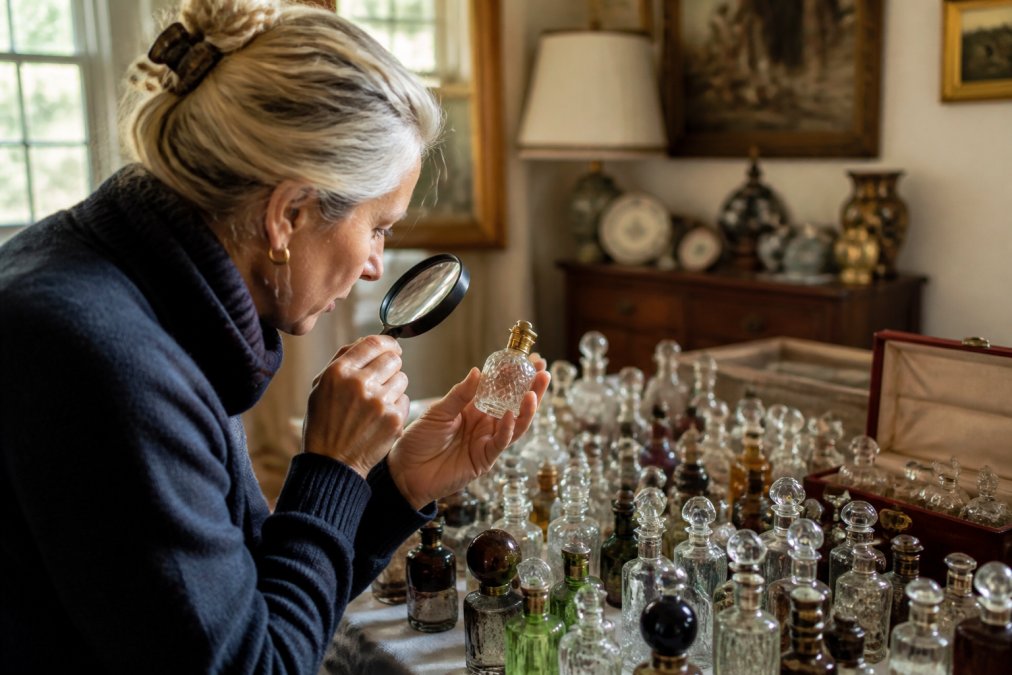
Batch codes are the fastest way to date a bottle and confirm it matches the era it claims. Learning how to identify vintage perfume batches means reading the code, the bottle style, and the label typography together, because no single signal is reliable on its own.
Most houses changed their coding systems every few years, so a code that reads as 1980s on one brand may read as 1990s on another. Cross-check three things: the code itself, the address printed on the label, and whether the packaging uses a barcode.
- Pre-barcode labels usually indicate production before the mid-1980s
- Address changes on the label often pin a bottle to a specific decade
- Embossed glass markings on the base can confirm the bottle manufacturer's era
What most guides miss is that the same fragrance was reformulated repeatedly, so two bottles with similar codes can smell completely different. Dating tells you the era; it does not tell you the juice survived.
Signs of Spoiled Vintage Perfume
Spoiled vintage perfume announces itself before you ever spray it. The most reliable signs are a darkened liquid, a sharp vinegar or nail-polish odor, and a top note that collapses within seconds of application.
Color alone is not proof of damage. Many vintage fragrances darken naturally as they age, and a deep amber hue can be perfectly healthy. The test is the smell, not the shade.
- Vinegar, acetone, or burnt-rubber notes on first spray
- A liquid that has separated into visible layers
- A cap or neck crusted with residue that will not wipe clean
- A sprayer that has seized or a stopper that has fused to the neck
Best Online Marketplaces for Vintage Fragrance
The best online marketplaces for vintage fragrance fall into three tiers: general resale platforms, dedicated fragrance forums, and specialist decant sellers. Each carries different risk, and matching the platform to the bottle's value is what separates a good buy from an expensive lesson.
General resale sites offer volume but weak authentication. Dedicated collector forums offer knowledgeable sellers but limited inventory. Specialist sellers who trade in Fragrance Foundation industry resources tend to be the most reliable for higher-value bottles.
| Source | Best For | Main Risk |
|---|---|---|
| General resale platforms | Common designer bottles | Counterfeits, poor storage |
| Collector forums | Rare discontinued releases | Limited buyer protection |
| Specialist decant sellers | Sampling before buying | Smaller volume per listing |
For anyone testing the waters, decants remove most of the risk. Olfactory Outlaws offers vintage decants like the Halston Halston 1-12 (Vintage) - Decant for $10.00, which lets you evaluate a classic composition before committing to a full bottle.
Authenticating Rare Vintage Perfumes
Authentication is where most buyers get burned, because counterfeiters target exactly the bottles collectors want most. Genuine vintage perfumes show consistent typography, correct glass weight, and a batch code that matches the label's stated era.
Halston Halston 1-12 (Vintage) – Decant →
Check the font first. Counterfeiters rarely reproduce period-accurate typefaces, and a modern sans-serif on a bottle claiming to be from the 1970s is an immediate red flag. Then weigh the bottle in your hand; vintage glass is typically heavier than modern reproductions.
- Compare the label font against archived advertisements from the same decade
- Verify the batch code against the brand's known coding system
- Inspect the sprayer or stopper for period-correct materials
- Ask the seller for a photo of the bottle's base, not just the front
The Federal Trade Commission guidance on counterfeit goods is clear that selling counterfeit products is illegal, which gives you real recourse if a purchase turns out to be fake. Keep your receipts and listing screenshots.
Storing Vintage Perfumes to Preserve the Scent
Storage decides whether a vintage bottle survives another decade. Heat, light, and oxygen are the three forces that destroy a fragrance, and controlling all three is simpler than most collectors assume.
Keep bottles upright in a cool, dark cabinet away from bathrooms, where humidity and temperature swing constantly. If you decant into smaller containers, fill them as close to the top as possible to limit the air gap.
- Store at a stable, cool temperature away from windows and radiators
- Keep bottles in their original boxes where you have them
- Avoid decanting into containers you cannot seal tightly
- Minimize how often you open a bottle you plan to keep long term
That is one reason curated decants from Olfactory Outlaws make sense for building a collection over time.
Conclusion: Building a Vintage Collection with Confidence
The hunt rewards patience and preparation far more than luck. Estate sales and auctions supply the finds, batch codes and authentication protect your money, and proper storage keeps each bottle alive for the next owner.
When you want verified vintage decants and expert guidance rather than guesswork, Olfactory Outlaws brings world-wide sourcing of niche and designer fragrances, personalized scent recommendations, and a concierge team that helps both newcomers and serious collectors. Our curated edits and monthly Bounty Box subscription service make it easy to explore rare houses without overcommitting.
Get started with Olfactory Outlaws and build a vintage collection you can actually trust.
Frequently Asked Questions
How can you tell if a vintage perfume is authentic?
Check the bottle for embossed logos, examine the label's typography and paper quality, and look for a batch code that matches the box. Authentic vintage perfumes often have slight imperfections in glass or printing that mass-produced fakes lack. Research the specific house's packaging history, and when possible, buy from sellers who provide detailed photos of the bottle's base, stopper, and any accompanying packaging.
Where is the best place to buy rare vintage perfumes online?
Specialty fragrance forums, estate sale aggregators, and dedicated vintage perfume auction sites are your best bets. General marketplaces like eBay can work if you vet sellers carefully. For curated options, Olfactory Outlaws offers vintage decants like Halston Halston 1-12 (Vintage) - Decant and Hugo Boss Hugo (Vintage) - Decant, letting you sample rare scents without committing to a full bottle. Always check return policies and seller feedback before purchasing.
Do vintage perfumes go bad over time?
Yes, vintage perfumes can spoil, especially if stored improperly. Signs of spoiled vintage perfume include a sharp vinegar-like top note, discoloration darker than expected, or a scent that smells flat or metallic. However, many well-stored vintage fragrances improve with age, developing richer base notes. Proper storage in a cool, dark place extends shelf life significantly.
How do you store vintage perfume to preserve the scent?
Keep bottles upright in a cool, dark place away from direct sunlight and temperature swings. Avoid bathrooms due to humidity. If the original box is available, store the bottle inside it. For decants, use glass atomizers rather than plastic, and keep them tightly sealed. Minimizing air exposure slows oxidation, which is the main cause of scent degradation.