

Table of Contents
- Why Identifying Fragrance Notes Changes How You Buy Perfume
- The Fragrance Pyramid Explained: Top, Heart, and Base Notes
- How to Train Your Nose for Perfume: 6 Exercises That Work
- How to Test Perfume Properly: A Step-by-Step Method
- Reading a Scent Profile: How Notes Evolve on Skin
- Synthetic vs. Natural Notes: What Changes in the Bottle
- Practice in the Wild: Using Decants to Learn Fragrance Notes
- Conclusion: Build Your Scent Vocabulary One Decant at a Time
- Frequently Asked Questions
Last Updated: October 4, 2026
Why Identifying Fragrance Notes Changes How You Buy Perfume
Learning how to identify perfume fragrance notes turns every bottle from a gamble into an informed choice.
Fragrance notes are the individual scent materials that make up a perfume, grouped by how quickly they evaporate. They are the building blocks of every composition.
Most people buy blind and hope. That is why so many full bottles sit untouched.
Below, we break down the pyramid, share six nose-training exercises, and show you exactly how to test perfume before you commit.
The Fragrance Pyramid Explained: Top, Heart, and Base Notes
The fragrance pyramid is a three-tier model that maps how a perfume unfolds over time. It groups notes by evaporation rate, from the fastest to the slowest. Understanding it is the fastest route to reading any scent profile.
Tier |
Timing |
Typical Notes |
What You Notice |
|---|---|---|---|
Top notes |
First 5-15 minutes |
Citrus, aldehydes, green notes |
Bright, sharp opening |
Heart notes |
20 minutes to 2 hours |
Floral, spice, fruit |
The main character |
Base notes |
2 hours onward |
Musk, resins, woods |
Depth and longevity |
Top Notes: The First Five Minutes
Top notes are the volatile materials you smell the moment the spray hits skin. Citrus, aldehydes, and light greens live here. They fade fast because they evaporate quickly.
Heart Notes: The Core of the Composition
Heart notes, also called middle notes, appear as the top notes burn off. This is the fragrance's true personality. Floral, fruity, and spicy accords dominate this stage.
Base Notes: What Lingers After Hours
Base notes are the fixatives that anchor everything else. Musk, ambergris, resins, and woods sit close to skin for hours. They define dry down and longevity.
How to Train Your Nose for Perfume: 6 Exercises That Work
Most guides tell you to "smell more things." That is not a method. Olfactory memory is built the same way muscle memory is: through repetition, isolation, and feedback. Below is a structured progression you can run in 10 minutes a day, ordered from easiest to hardest. Do not skip ahead, each stage assumes the vocabulary from the one before it.
Stage 1: Build a Reference Library (Weeks 1-2)
You cannot identify what you have never smelled in isolation. Before you can pick out bergamot inside a finished perfume, you need a clean memory of bergamot alone.
- Single-note smelling. Smell one raw material at a time: lemon peel, black pepper, cinnamon stick, coffee grounds, vanilla extract, fresh rosemary. Say the name out loud as you inhale. Naming forces the brain to file the scent under a label instead of a vague feeling.
- Olfactory memory journal. Log every scent with three fields: the material, the date, and one adjective beyond "good" or "bad" (sharp, creamy, powdery, green, resinous). Revisit the same material a week later and compare your adjectives. If they match, the memory is sticking.
- Scent walks. Note what is actually on your street: rain on asphalt, cut grass, bakery exhaust, dry cleaner solvent. These are free reference points you pass every day.
Stage 2: Build Discrimination (Weeks 3-4)
Once you have 15-20 references, start separating them.
- Blind identification. Have someone hand you three labeled strips face-down. Guess each note before checking. Track your hit rate in the journal.
- Pairing drills. Smell two notes together, say, lemon and vanilla, and describe how they interact. Does one dominate? Do they blend into something new? This is the skill that lets you hear individual instruments inside a chord.
- Triangle tests. Put three strips in front of you: two of the same material, one different. Identify the odd one out. This is the same format used in professional sensory panels, and it trains fine discrimination fast.
Stage 3: Read Finished Fragrances (Week 5 onward)
- Focused re-sniffing. Revisit one fragrance at hour one, hour three, and hour six. Write down what changed. Over time you will start predicting the transition before it happens.
- Accord deconstruction. Pick a fragrance you know well and try to name three notes you can smell simultaneously. This is the bridge from identifying single notes to reading accords, see the section below on notes versus accords.
How to Know It Is Working
You are making progress when you can do three things: name a note without seeing the bottle, describe how two notes interact, and predict roughly when a fragrance will shift from heart to base. If you can do all three, you can read a scent profile before you ever smell the perfume.
How to Test Perfume Properly: A Step-by-Step Method
Testing perfume properly means controlling for skin chemistry, timing, and spray distance. Follow these steps for a clean read.
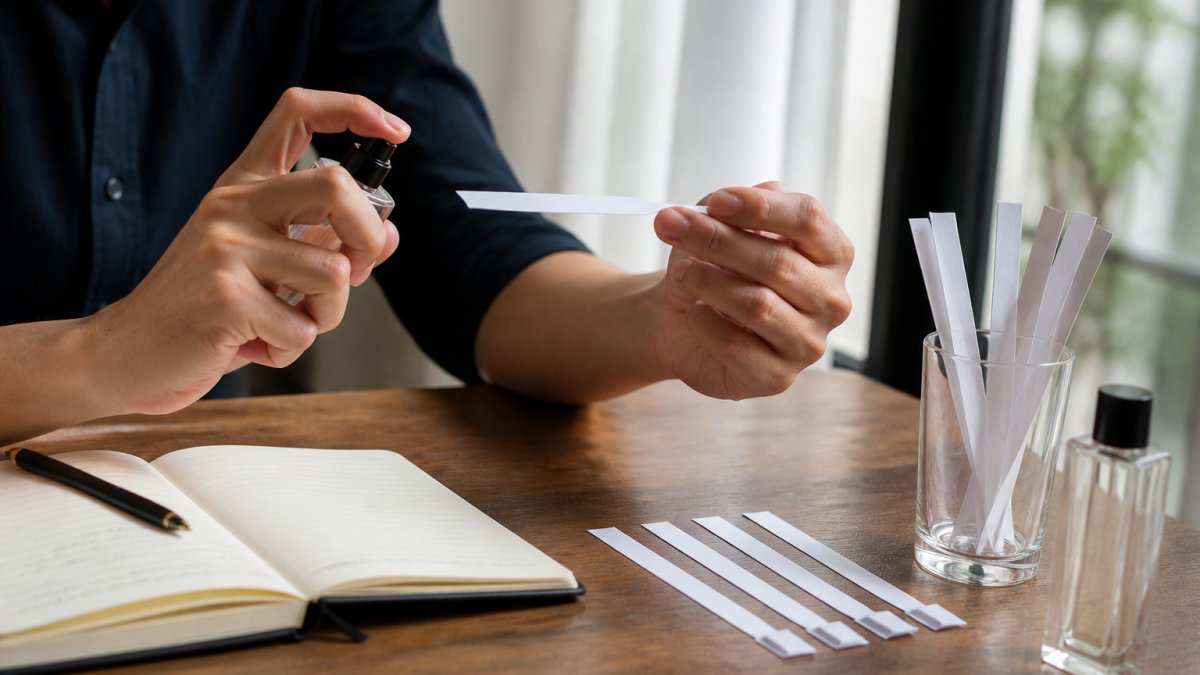
- Prep your skin. Spray on moisturized, unscented skin. Dry skin eats fragrance faster.
- Limit to two per visit. More than that and your nose shuts down.
- Spray one wrist, one inner elbow. Keep test zones separate.
- Wait 30 minutes. Do not judge the opening. Judge the heart.
- Check at hour two and hour six. Note the dry down and longevity.
- Write it down. Record the notes you picked up and how they changed.
Reading a Scent Profile: How Notes Evolve on Skin
A scent profile is the full written description of a fragrance's notes and how they develop.
Skin chemistry changes everything. Oily skin holds base notes longer. Dry skin pushes top notes to the front. Body heat, pH, and even diet shift perception.
What most guides miss is that a scent profile describes the fragrance, not your experience of it. Two people wearing the same perfume can smell like two different perfumes.
Synthetic vs. Natural Notes: What Changes in the Bottle
Most guides stop at "naturals are complex, synthetics are consistent." That tells you nothing about how to identify which is which when you are smelling a strip. This section covers the texture differences you can actually train your nose to detect.
Aroma compounds are the individual molecules that create a scent. A natural extract, say, rose absolute, contains hundreds of these molecules, and their ratios shift from harvest to harvest.
Moth And Rabbit Perfumes Dolls – Decant →
How to Tell Them Apart by Smell
You are not detecting a chemical signature. You are detecting a texture. Here is what to listen for:
- Naturals feel rounder and slightly "fuzzy" at the edges. A natural citrus like bergamot has a bitter, almost soapy facet alongside the bright top. A natural rose smells jammy and slightly waxy, with a honeyed undertone.
- Synthetics feel sharper, cleaner, and more linear. Hedione (a synthetic jasmine-like molecule) smells bright and airy but does not evolve the way real jasmine does. Iso E Super reads as a smooth, velvety wood with almost no texture variation from minute to minute.
- Synthetics often last longer and project further. This is not a flaw, it is the point. A natural citrus top note may vanish in 20 minutes. A synthetic citrus aromachemical can hold for hours.
Why This Matters for Identification
When you smell a fragrance and something feels too smooth, too consistent, or too loud for its note category, you are likely smelling a synthetic.
Most modern perfumes are a blend of both. A common pattern is a natural heart note supported by a synthetic base to extend longevity, or a synthetic top note used to brighten a natural heart.
Common Synthetic Stand-Ins to Learn
If you want to train this skill, learn these pairs side by side:
- Natural jasmine vs. hedione, the synthetic is brighter and more transparent.
- Natural sandalwood vs. Iso E Super or Javanol, the synthetics are smoother and less creamy.
- Natural ambergris vs. Ambroxan, the synthetic is cleaner and saltier without the animalic edge.
Practice in the Wild: Using Decants to Learn Fragrance Notes
Decants are the smartest way to study fragrance notes without committing to full bottles. A decant is a small portion of a fragrance transferred from the original bottle.
For example, our Moth And Rabbit Perfumes Dolls - Decant opens with cherry blossom, davana, geranium, and orange blossom, then moves through maple syrup, ylang-ylang, rose oil, and apple blossom, before landing on snow, musk, animal notes, ambergris, and cedar.
Compare that to our Moth And Rabbit Perfumes Parasite - Decant, which runs grass and aldehydes up top, water notes, lily-of-the-valley, and freesia in the heart, then ambroxan, patchouli, vetiver, musk, guaiac wood, and myrrh at the base.
Our Moth And Rabbit Perfumes Dreamers - Decant teaches the powdery side: aldehydes, violet, and geranium, then iris, lily-of-the-valley, rose, Siam benzoin, and tonka bean, finishing with sandalwood, musk, myrrh, patchouli, incense, cedar, and vanilla.
And Moth And Rabbit Perfumes Duke Of Burgundy - Decant shows how animalic notes work: peach, davana, green notes, angelica, and freesia, then skin, leather, osmanthus, cereals, and jasmine, closing on musk, varnish accord, animal notes, amber, sandalwood, heliotrope, and Virginia cedar.
At Olfactory Outlaws, our concierge team helps you pick decants that stretch your nose instead of repeating what you already know.
Fragrance fans who want to study notes across many houses without buying full bottles.
Conclusion: Build Your Scent Vocabulary One Decant at a Time
The hardest part of learning fragrance notes is knowing where to start. Random sampling wastes money. Guided discovery builds real skill.
Olfactory Outlaws offers expert-led fragrance consultation, curated decants, and our monthly Bounty Box subscription.
Get started with Olfactory Outlaws and build a scent vocabulary that lasts a lifetime.
Frequently Asked Questions
What is the difference between top, middle, and base notes?
Top notes appear first and last 5 to 15 minutes, built from volatile molecules like citrus and aldehydes. Heart notes emerge as top notes fade, lasting 1 to 4 hours and defining the fragrance's character with florals, spices, or fruits. Base notes anchor the composition for 4 to 12 hours or more, using heavier materials like musk, ambergris, resins, and woods. The olfactory pyramid maps this evaporation rate so you can predict how a scent will shift from first spray to dry down.
How can I train my nose to identify specific fragrance notes?
Start with single-note reference materials. Smell each one for 10 seconds, then write down three descriptors. Repeat daily for two weeks, adding one new material every few days. Next, smell a known fragrance and try to pick out two notes before checking its pyramid. This builds olfactory memory. Olfactory Outlaws offers curated decants so you can practice with niche fragrances without committing to full bottles.
Why does a perfume smell different on me than on a tester strip?
Skin chemistry, body heat, moisture, and pH all affect how aroma compounds evaporate. A tester strip is neutral paper, so it shows the composition as the perfumer intended. On skin, oils and sweat can amplify some notes and mute others. Dry skin may hold base notes longer while losing top notes quickly. Always test on your own skin, not just paper, and wait at least 30 minutes before deciding. The dry down phase reveals the truest version of the fragrance on you.
Do fragrance notes change over time on the skin?
Yes. Perfume is designed to evolve through three phases: top, heart, and base. Top notes evaporate within 15 minutes. Heart notes take over for the next few hours. Base notes emerge as the scent settles and can last 8 hours or more. This progression is called scent evolution or dry down. Temperature, humidity, and your skin's oiliness affect the speed. Testing a fragrance for a full day gives you the complete arc rather than just the opening.