

Table of Contents
- Why Temperature Swings Break Down Fragrance
- How to Store Perfume to Last: The 5 Rules That Actually Work
- Light, Air, and Humidity: The Three Enemies of Scent Integrity
- Best Storage Containers for Perfume: What to Buy and What to Skip
- Perfume Shelf Life: How Long Each Concentration Actually Lasts
- How to Tell If Perfume Has Gone Bad
- Travel Storage and Decanting: Protecting Fragrance on the Move
- Display vs. Preservation: Finding the Right Balance for Your Collection
- Frequently Asked Questions
Last Updated: September 20, 2026
Why Temperature Swings Break Down Fragrance
Learning how to store perfume to last starts with one uncomfortable truth: most bottles die from temperature swings, not age. Degradation accelerates every time the liquid expands and contracts, which happens fastest in rooms that heat and cool daily. A fragrance stored at a steady 60°F will outlast an identical bottle on a sunny dresser by years.
How to Store Perfume to Last: The 5 Rules That Actually Work
Five habits protect a fragrance collection: steady temperature, total darkness, low humidity, an airtight seal, and keeping the bottle in its original packaging. Follow all five and most fragrances hold their scent profile for years past the printed date.
- Keep the bottle out of direct sunlight and away from radiators
- Store at a steady temperature, ideally 60-65°F
- Keep humidity low; avoid steamy rooms entirely
- Tighten the cap after every use
- Return the bottle to its box between wears
Rule 1: Keep It Cool, Not Cold
Cool means stable, not freezing. A dark closet shelf or low drawer in a climate-controlled room is the sweet spot. The refrigerator backfires: every door opening jolts the temperature, cold can separate or cloud components, and thermal shock distorts how a scent opens.
Rule 2: Block All Light
Ultraviolet light is the fastest way to wreck top notes. Citrus, green, and aquatic accords fade first because their molecules are most light-sensitive, and tinted glass only slows the damage. Keep the bottle in its original box or an opaque drawer.
Rule 3: Control Humidity
High humidity pushes moisture past the cap seal into the juice, shifting the chemical composition and inviting bacterial growth. Bathrooms and kitchen windowsills are the worst offenders; a bedroom closet or interior drawer keeps humidity low and steady, which is what the atomizer and cap seal need to stay tight.
Light, Air, and Humidity: The Three Enemies of Scent Integrity
Air exposure is the enemy most collectors underestimate. Every spray pulls fresh oxygen into the bottle, driving oxidation once the seal weakens. Keep bottles tightly capped, avoid decanting more than you'll use in a few months, and never store fragrance with the cap off "to let it breathe."
Why Direct Sunlight and UV Exposure Ruin Top Notes
Direct sunlight does more damage in a week than a year in a drawer. UV breaks the molecular bonds in the most fragile aromatics, so a sun-bleached bottle loses its opening sparkle long before the base fades. Clear glass is most vulnerable, and a citrus-forward eau de toilette shows damage far sooner than a dense oriental.
Why the Bathroom Is the Worst Place for Your Fragrance Collection
The bathroom combines every risk factor: shower heat, humidity that never clears, and constant temperature swings as the door opens and closes. A bottle on the vanity is slowly cooked. If a fragrance smelled different six months after you bought it, the bathroom shelf is usually why.
Best Storage Containers for Perfume: What to Buy and What to Skip
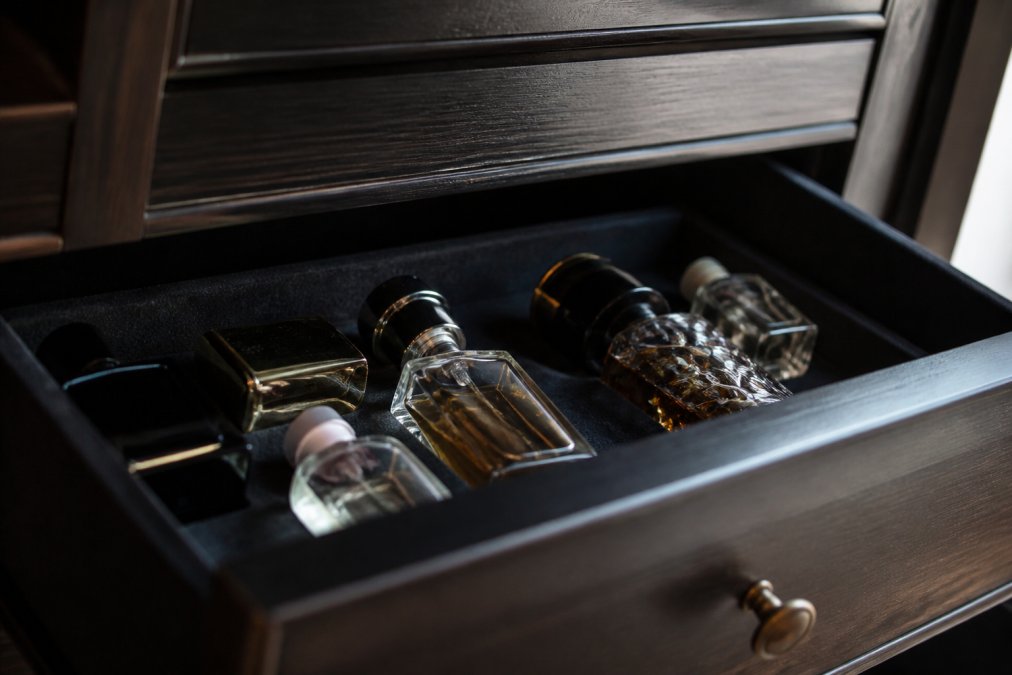
The best storage containers for perfume are opaque, airtight, and sized so bottles don't rattle. You don't need a specialty case, but avoid clear acrylic displays and open trays that expose glass to light and air.
| Container | Best For | Watch Out For |
|---|---|---|
| Original box in a drawer | Everyday storage | Boxes wear out over time |
| Opaque travel case | Decants and travel | Foam inserts can trap heat |
| Velvet-lined wooden box | Display plus protection | Not airtight on its own |
| Clear acrylic tray | Short-term display only | Offers zero UV protection |
| Fridge shelf | Long-term unopened backups | Thermal shock on daily use |
Perfume Shelf Life: How Long Each Concentration Actually Lasts
Shelf life is not a fixed number on a box. It depends on how much alcohol and how many fragile top-note molecules a formula carries, and how well the bottle is sealed against oxygen, light, and heat. A fragrance boxed in a 60-65°F closet can smell correct for a decade or more; the same bottle on a bathroom vanity can turn in six to twelve months.
Why Alcohol Content Drives the Clock
Perfume is a solution of aromatic compounds in alcohol and water. Alcohol is volatile, which is why a spray dries down and projects, but it also means the liquid constantly tries to leave the bottle. Once the cap seal loosens or the atomizer collar cracks, alcohol escapes into the headspace and carries the lightest molecules with it.
Concentration-by-Concentration Breakdown
- Cologne (Eau de Cologne): the lowest oil concentration and highest alcohol load. Bright citrus and herbal openings are most vulnerable to light and heat, so a cologne is often the first bottle to smell flat. Expect noticeable top-note loss in as little as a year on a shelf.
- Eau de Toilette: more oil than a cologne but still alcohol-forward. The opening sparkle fades first; the heart and base hold for several years under good conditions. Storage habits show up fastest here in a side-by-side sniff test.
- Eau de Parfum: the balance point most collectors build around. Higher oil content means base notes resist oxidation longer, and a well-stored bottle holds its profile five to ten years or more. Heat is the main threat, turning a dense formula syrupy or muddy rather than simply fading.
- Parfum / Extrait: the densest, slowest-degrading concentration, and the most expensive per milliliter, so the most worth protecting. Extraits react to heat and light differently: instead of losing top notes, they develop a heavy, off-sweet or resinous cast after repeated temperature swings.
- Solid perfumes and oils: no alcohol carrier means no evaporation-driven top-note loss, but the wax or oil base can go rancid or pick up dust and bacteria. Keep them sealed, cool, and out of humid rooms.
The Storage Multiplier
Concentration is the baseline; storage is the multiplier. A badly stored parfum can degrade faster than a well-stored eau de toilette. The three levers are seal integrity, light exposure, and temperature stability. A bottle with a compromised seal is on a fast clock no matter how precious the juice.
A Practical Rule of Thumb
To decide what to use first, work from most fragile to most stable: colognes and light eau de toilettes up front, eau de parfums in the middle, extraits and rare backups archived in their boxes. The bottles most likely to lose their opening sparkle get worn at their best, while denser formulas wait safely.
How to Tell If Perfume Has Gone Bad
Perfume has gone bad when the opening smells sharp, sour, or like nail polish remover instead of what you remember. The clearest signs: a color shift toward dark amber, cloudy or separated liquid, and a scent that turns metallic within minutes of spraying.
Run this quick check before you toss a bottle:
- Spray on paper, not skin, and smell at the one-minute mark
- Compare the opening against your memory of the original
- Look for sediment, cloudiness, or a darkened liquid
- Check whether the cap seal still fits snugly
- Note if the base notes arrive too fast, skipping the top entirely
Travel Storage and Decanting: Protecting Fragrance on the Move
Travel is where most collections take real damage. Luggage holds swing between hot tarmac and cold cargo, in-flight pressure changes push on every seal, and a loose bottle in a toiletry bag gets knocked against zippers for hours. The fix is not leaving fragrance at home; it is decanting deliberately and packing like the bottle is fragile, because it is.
Why Travel Atomizers Are Riskier Than They Look
A travel atomizer is a small, refillable spray bottle, usually 5-10 mL, filled from a full-size bottle. Convenient, but it introduces three problems the full bottle does not:
- Plastic and low-grade glass can interact with the juice. Alcohol is a solvent; over weeks in a cheap plastic atomizer it pulls compounds from the container wall into the fragrance, so a decant can smell slightly "off" even when the source bottle is fine. Glass atomizers with metal sprayer assemblies are safer.
- The seal is the weak point. Travel atomizers rely on a small gasket and a screw or crimp collar. Cabin pressure changes plus repeated opening wear that seal fast, and a leaking decant can empty itself and damage everything around it.
- Foam inserts trap heat. Many travel cases use foam or dense padding. That protects against impact but insulates the bottle, so a case left in a hot car holds heat in rather than letting it dissipate.
A Packing Method That Actually Protects the Bottle
- Decant only what the trip requires. A 5-10 mL atomizer covers a week of normal wear; don't travel with a full 100 mL bottle unless you have no alternative.
- Use glass, not plastic. If you must use plastic, treat the decant as short-term and transfer it back to glass at home.
- Wrap each bottle individually. A sock, padded pouch, or cloth wrap absorbs impact and keeps the cap from being pressed sideways; the cap seal fails most often under pressure.
- Keep the case in your carry-on. The cabin is temperature-controlled and pressurized; checked luggage is not.
- Store the case upright and away from the cabin wall. The aircraft wall gets cold, and a bottle pressed against it sees a sharper temperature swing.
- Re-seal the source bottle at home. Tighten the original cap fully and return the full bottle to its box before you leave. A decant is only as good as the bottle it came from.
How Long a Decant Lasts
A properly stored glass decant holds its scent integrity for several months, enough for a trip and a reasonable sampling window. A plastic decant is a weeks-long container, not a months-long one. If you use decants to test before buying a full bottle, keep them cool and dark at home between trips rather than in a hot car or sunny windowsill.
Travel and the Rest of Your Collection
The same rules protect a bottle on the road: steady temperature, darkness, a tight seal, and low humidity. Travel just compresses the timeline and removes your control over the room. Pack accordingly, and the bottles you leave behind will be exactly as you left them.
Display vs. Preservation: Finding the Right Balance for Your Collection
Climate matters too. In hot, humid regions, prioritize an interior closet over any shelf, and consider a wine-style cooler set to a steady temperature for high-value bottles. In dry climates, humidity is less of a threat, but temperature swings near windows and exterior walls still are.
Frequently Asked Questions
Can you still use 20-year-old perfume?
It depends on how it was stored. A fragrance kept in a cool, dark place with its cap sealed can remain wearable for decades, though top notes often fade first. If it was exposed to heat, light, or humidity, oxidation may have turned it sour or sharp. Test a small amount on skin before wearing it out. If the scent smells off or the liquid has darkened significantly, it has likely passed its usable shelf life.
Is it okay to store perfume lying down?
Standing upright is better. Lying a bottle down lets the liquid sit against the cap seal and atomizer, which increases the chance of leaks and air exposure over time. Air is one of the main drivers of fragrance degradation. If you must lie a bottle down for travel, wrap it tightly and return it upright as soon as possible to protect the cap seal and keep the chemical composition stable.
Does sunlight ruin perfume?
Yes. UV exposure breaks down the volatile compounds that make up a fragrance, especially the top notes. Even a few hours on a sunny windowsill can start the process. That is why original packaging and opaque containers matter: they block light sensitivity issues before they begin. A cool dark place, such as a closet or drawer, protects scent integrity far better than any open shelf.
Should perfume be kept in the refrigerator?
A fridge can work if the temperature stays steady, but most kitchen refrigerators cycle through temperature fluctuations every time the door opens. That thermal shock stresses the chemical composition. A dedicated mini-fridge set to a consistent cool temperature is safer than the main one. For most collections, a closet or drawer away from heat and light is the simpler, more reliable choice.