

Table of Contents
- Do Perfume Decants Expire Quickly?
- How Long Do Fragrance Decants Last
- Factors That Affect Fragrance Degradation in Decants
- Signs of Expired Perfume You Should Know
- How to Store Perfume Decants Properly
- Maximizing Decant Longevity: Practical Tips
- Frequently Asked Questions
Last Updated: September 21, 2026
Do Perfume Decants Expire Quickly?
The short answer: perfume decants don't expire quickly if stored properly, but they degrade faster than full bottles. At Olfactory Outlaws, we guide fragrance enthusiasts through the reality of decant longevity, and the truth is more nuanced than most retailers admit. A well-sealed decant can last 2-3 years or longer, while a poorly stored one might lose its scent profile within months. The difference comes down to understanding what actually damages fragrance and taking deliberate steps to prevent it.
Decant longevity depends on seal integrity, storage conditions, and chemical composition, not size alone. What matters is how much air is inside the vial and how well it's sealed.
How Long Do Fragrance Decants Last
Fragrance decants typically last 2-3 years when stored correctly; full bottles last 3-5 years or more because their larger volume creates a smaller air-to-fragrance ratio, slowing oxidation.
A decant stored in a cool, dark closet will outlast one on a sunny shelf by years. Temperature fluctuations and light exposure accelerate fragrance breakdown, while excessive humidity compromises seal integrity.
Decants vs. Full Bottles: The Shelf Life Difference
Full bottles have less headspace, meaning less oxygen triggers oxidation. Their larger volume also buffers against temperature swings better than decants.
Decants sacrifice longevity for accessibility. Their smaller format means more surface area relative to volume, faster evaporation, and greater impact from seal imperfections.
A properly sealed decant outperforms a carelessly stored full bottle. Environment matters more than container size.
Factors That Affect Fragrance Degradation in Decants
Several forces work against your decants simultaneously. Understanding each one helps you defend against them strategically.
Air Infiltration and Oxidation
Oxygen is fragrance's primary enemy. Air contact triggers oxidation, breaking down fragrance molecules. Top notes fade first, leaving a flat, muted scent.
Oxidation speed depends on seal quality. A loose cap oxidizes noticeably within weeks; a hermetic seal slows oxidation dramatically.
Top notes are most susceptible to oxidation. Prolonged air exposure turns crisp, bright fragrances musty or flat.
Temperature Fluctuations and Light Exposure
Heat accelerates chemical reactions. Each degree of temperature increase roughly doubles degradation rate.
UV light destabilizes fragrance molecules. Darkness is the best protection; opaque containers preserve scent far longer than visible shelf storage.
Avoid bathroom storage due to temperature swings and humidity spikes. A bedroom closet or cool hallway cabinet is better.
Vial Material and Seal Integrity
Glass thickness, cap design, and seal material influence stability. Thicker glass and rubber/silicone gaskets create tighter seals than plastic caps alone.
Atomizers with one-way valves minimize air infiltration and outlast simple spray mechanisms.
Test seal integrity by inverting the decant. Any leaking indicates compromised longevity.
Signs of Expired Perfume You Should Know
Perfume degrades when the scent profile shifts noticeably: top notes vanish, heart notes mute, and off-notes (sour, musty, or chemical smells) appear.
Color change is another indicator. Many fragrances darken slightly over time as compounds oxidize. A noticeable shift from clear to yellow or amber suggests oxidation has progressed significantly. Some fragrances naturally darken, so this alone isn't definitive, but combined with scent changes, it signals degradation.
The most reliable sign is performance. A degraded fragrance projects less, lasts shorter on skin, and feels thin compared to a fresh decant of the same scent. If a fragrance that once lasted 6 hours now fades after 2, oxidation has compromised the volatile compounds responsible for longevity.
How to Store Perfume Decants Properly
Storage strategy determines whether your decants last months or years. The fundamentals are straightforward, cool, dark, dry, and sealed, but the why behind each condition and the how of implementation separate collectors who preserve their fragrances from those who watch them degrade.
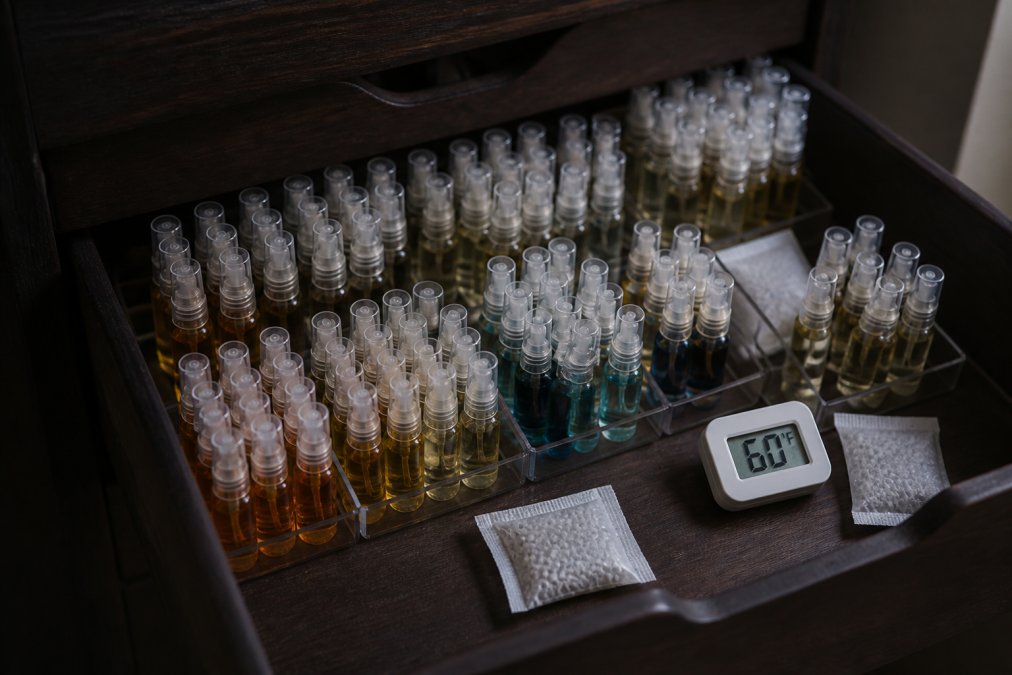
Temperature Control: The Chemical Accelerant
Temperature is the single most powerful variable you control. Fragrance degradation follows the Arrhenius equation, a chemistry principle stating that reaction rates roughly double for every 18°F (10°C) increase in temperature. This means a fragrance stored at 75°F will degrade twice as fast as one stored at 57°F. The difference between a decant lasting 2 years and lasting 4 years often comes down to a 15-20°F difference in storage temperature.
Ideal storage temperature is between 55°F and 65°F. This range is cool enough to slow oxidation and evaporation significantly, yet warm enough that the fragrance remains liquid and won't separate. A bedroom closet in a climate-controlled home typically maintains this range year-round. Basements work well if they stay dry and don't experience seasonal temperature swings.
Avoid these locations:
- Kitchens: Heat from appliances and cooking creates temperature spikes.
- Bathrooms: Humidity from showers and temperature swings from hot water are fragrance killers.
- Windowsills: Direct sunlight and temperature fluctuations from day-night cycles accelerate degradation.
- Near heating vents or air conditioning returns: These create micro-climates with unstable temperatures.
- Garages: Temperature swings between seasons are extreme, and many garages lack climate control.
If your home doesn't have a naturally cool area, consider a small wine cooler or insulated storage box. A wine cooler maintains 45-65°F. For serious collectors, this is a worthwhile investment.
Darkness: Blocking UV Degradation
UV light destabilizes fragrance molecules directly through photochemical reactions. Even indirect sunlight (light passing through a window but not direct rays) will degrade a fragrance noticeably over months. The effect is cumulative: a decant exposed to 2 hours of indirect sunlight daily will show color change and scent degradation within 6 months.
Storage solutions:
- Opaque storage boxes: Cardboard or plastic boxes that block all light. Cost: $5-15. Effectiveness: excellent. A simple cardboard box in a closet is one of the cheapest and most effective solutions.
- Dedicated fragrance storage cases: Purpose-built cases with foam inserts and UV-blocking material. Cost: $20-60. Effectiveness: excellent, plus organization benefits.
- Dark glass bottles or amber vials: If you transfer decants to secondary storage, use amber or cobalt glass, which blocks UV. Clear glass offers no protection.
- Drawer or cabinet storage: Any opaque container works. A kitchen drawer, bedroom dresser drawer, or closet shelf all work equally well as long as light doesn't reach the decants.
If you keep decants visible for aesthetic reasons, accept that you're trading longevity for display. A decant on a shelf will degrade 2-3x faster than one in a dark cabinet, even if the shelf is indoors and not in direct sunlight.
Humidity and Moisture Control
Excessive humidity (above 60% relative humidity) compromises seal integrity and introduces water into the vial. Water in fragrance causes several problems: it dilutes the scent, promotes bacterial growth, and can cause the fragrance to separate or turn cloudy. Humidity also accelerates corrosion of metal components in atomizers.
Keep humidity below 60% in your storage area. Most homes naturally stay in the 30-50% range, so this is usually not a concern unless you live in a humid climate or store decants in a basement prone to moisture.
If humidity is an issue:
- Add silica gel packets: Place 1-2 small silica gel packets (the kind found in vitamin bottles or electronics packaging) in your storage box. They absorb moisture and can be recharged by heating in an oven at 250°F for 2 hours. Cost: $3-8 for a reusable set.
- Use a small dehumidifier: For a closet or cabinet, a compact electric dehumidifier ($20-40) maintains humidity below 50%.
- Avoid basements in humid climates: If your basement experiences seasonal moisture, store decants elsewhere.
Orientation and Positioning
Store decants upright unless the cap has a one-way valve. An upright position minimizes the fragrance's contact with the cap and reduces evaporation. The cap is often the weakest point in the seal, so keeping liquid away from it extends longevity.
Horizontal storage (decants lying on their side) increases the surface area of fragrance in contact with the cap and accelerates evaporation. This matters more for decants with weaker seals; a premium decant with a silicone gasket will tolerate horizontal storage better than a budget decant with a plastic-only cap.
If you stack decants, use dividers or soft padding between them to prevent the cap of one from pressing against the vial of another.
Travel-Specific Storage Solutions
Traveling with decants requires extra precaution because luggage, vehicles, and aircraft cabins expose fragrances to conditions far harsher than home storage.
Maximizing Decant Longevity: Practical Tips
A few deliberate practices extend decant life significantly. First, minimize air exposure every time you open the vial. Spray quickly and close the cap immediately. Each opening allows air in and fragrance volatiles out.
Frequently Asked Questions
How long do perfume decants last compared to full bottles?
Perfume decants typically last 1-3 years when stored properly, while full bottles can last 3-5 years or longer. The difference comes down to surface area exposure. Decants have a higher ratio of liquid surface to air space, meaning more fragrance molecules escape through evaporation and oxidation. A sealed full bottle creates a more stable environment, slowing chemical degradation and volatile compound loss. Proper storage, cool, dark, airtight conditions, can extend decant longevity significantly.
What are the signs that a perfume decant has expired?
Expired perfume decants show clear warning signs: color changes (darkening or yellowing), altered scent profile (top notes disappearing, base notes becoming heavier or off), a sour or vinegary smell, or visible cloudiness. The fragrance may also smell weaker or develop an unpleasant chemical odor. If the atomizer is loose or the seal has failed, oxidation accelerates these changes. Trust your senses, if it smells wrong or looks different from when you received it, the scent integrity has degraded and it's time to replace it.
Does decanting perfume ruin the scent or cause it to expire faster?
Decanting itself doesn't ruin perfume if done correctly with clean, airtight containers. However, the decanting process does expose fragrance to air briefly, which can trigger minor oxidation. The real risk comes after decanting: smaller vials have less stable storage conditions and higher evaporation rates due to increased air infiltration over time. Hermetic seals and quality vial materials matter enormously. When decants are stored in proper conditions with intact seals, they preserve scent integrity well, but they do expire faster than full bottles simply due to their smaller volume and surface-area-to-liquid ratio.
How can I test if a decant's seal is still intact?
Check for a tight seal by gently pressing the atomizer cap, it should feel snug with no wobbling or rattling. Look for any visible gaps, cracks, or discoloration around the cap and neck of the vial. Smell near the cap; if you detect fragrance escaping before you spray, air infiltration is occurring. Weigh the decant if you have a scale; significant weight loss over months suggests evaporation through a failing seal. For travel decants, test the seal before packing by placing it upside down on a tissue for a few minutes, no leaking means the seal is holding.