

Quick Summary
A niche perfume is a fragrance from a smaller, independent house with limited distribution and a focus on creative freedom, while a mainstream or designer perfume is made for broad appeal and wide availability. Niche scents tend to be more distinctive, and mainstream scents tend to be easier to find and more familiar.
- Niche houses often compose for an individual taste, while designer houses compose for a large audience.
- Niche perfumes are harder to find in stores and often cost more per bottle.
- Test fragrances on skin over a full day, not on paper strips.
- Buy a decant or small sample before committing to a full bottle.
- The niche label reflects brand intent, not guaranteed quality or wearability.
Table of Contents
- Niche vs Mainstream Perfume: Which Suits You Best
- What Is the Difference Between Niche and Mainstream Perfume?
- Niche vs Mainstream Perfume at a Glance
- Ultra Niche Perfume Meaning and Where the Categories Blur
- Niche vs Designer Fragrance Examples You Can Compare
- Niche Perfume Brands and What Sets Them Apart
- Niche Perfume Longevity, Projection and Price Compared
- Choosing Your Next Scent With Less Risk
- Frequently Asked Questions
Niche vs Mainstream Perfume: Which Suits You Best
Last Updated: November 24, 2026
What Is the Difference Between Niche and Mainstream Perfume?
A niche perfume is a fragrance made by a smaller, independent house with limited distribution and a focus on creative freedom.
Our catalog holds niche and designer examples side by side, so you can compare them directly. The clearest way to think about it is scale. Niche houses often compose for an individual taste, while designer houses compose for a large audience.
Keep in mind that the categories blur. Some designer fragrances are inventive, and some niche fragrances are easy to wear. The label tells you about the brand's intent, not guaranteed quality.
Niche vs Mainstream Perfume at a Glance
The table below sets out the practical differences. Treat it as a starting point, since individual houses vary.
| Factor | Niche Perfume | Mainstream / Designer Perfume |
|---|---|---|
| Creative direction | Perfumer-led, unusual compositions | Built for broad, familiar appeal |
| Availability | Limited distribution, smaller runs | Widely sold, easy to find |
| Typical buying format | Full bottles, decants, samples | Full bottles, often in retail stores |
| Scent originality | Higher chance of unusual accords | Lower chance of surprises |
| Best for | Buyers who want something distinctive | Buyers who want a reliable, familiar scent |
Pros of niche perfume: distinctive scents, greater creative freedom, and harder-to-find fragrances.
Cons of niche perfume: harder to find in stores, a narrower range of wearability, and a higher cost per bottle in many cases.
Pros of mainstream perfume: easy to find, familiar scent profiles, and broad wearability.
Cons of mainstream perfume: fewer surprises and a higher chance of smelling like many other fragrances.
Ultra Niche Perfume Meaning and Where the Categories Blur
Ultra niche is a term for very small, highly exclusive houses with tiny production runs. Ultra niche perfume sits at the far end of the spectrum, where scarcity and originality are the main selling points.
The boundaries are not sharp. A large designer house may release a bold, experimental scent that feels niche. An independent house may produce a crowd-pleasing fragrance that reads as mainstream. Judge each bottle on its notes and wear, not only its label.
Niche vs Designer Fragrance Examples You Can Compare
Comparing examples helps more than comparing definitions. Our catalog includes several decants that show how different styles compare.
Moschino Toy 2 Bubblegum decant, priced at $7.00, is a playful, fruity and floral scent built on candied notes and musk. Le Monde Gourmand Le Soda Pop decant, at $5.00, leans on a cola top note, jasmine heart and sugar cane base. Both are sweet and easy to notice, which makes them a useful pair to compare on mood and wearability.
Moth And Rabbit Perfumes Dolls decant, at $25.00, is more unusual. Its cherry blossom, maple syrup and snow accord create an uncanny, layered profile.
Use the examples to test your own preferences. If you enjoy a bold, unexpected scent, the Dolls decant may suit you. If you want something polished and wearable, the 17 Oud Mosaic decant is a better starting point.
Decant prices from the catalog
Niche Perfume Brands and What Sets Them Apart
Niche perfume brands differ mainly in their creative approach. Some focus on a single signature style, while others release a varied range of compositions.
Here is how the brands in our catalog differ:
- Moth And Rabbit Perfumes Dolls: An unsettling blend of florals and animalic warmth, built for buyers who want a scent that tells a story.
- Banana Republic 17 Oud Mosaic: A modern oud composed by master perfumer Claude Dir, designed to be versatile and approachable.
- Le Monde Gourmand Le Soda Pop: A playful gourmand that turns a familiar soft drink into a wearable fragrance.
- Moschino Toy 2 Bubblegum: A candy-inspired fruity floral, aimed at buyers who enjoy sweet, nostalgic notes.
Look at the notes and the overall mood before deciding. The brand name alone rarely tells you how a scent will wear.
Niche Perfume Longevity, Projection and Price Compared
Performance is the topic where category labels mislead most. Treat performance as a property of the specific formula and your skin, not of the niche-versus-mainstream label. For a cost-per-wear breakdown of niche prices, see how price compares to actual performance before buying.
Longevity, projection, and sillage are three different measurements
- Longevity is how long the scent remains detectable on your skin, usually measured in hours from application to the point where you can no longer smell it up close.
- Projection is how far the scent radiates from your body while you are wearing it. A scent with strong projection is noticeable at arm's length or across a room; a skin scent stays within a few inches.
- Sillage is the trail a fragrance leaves behind as you move. A scent can have modest projection but a long, recognizable sillage, which is why people often smell you after you have left a room rather than while you are standing in it.
Judge each one separately when you test.
What actually changes performance
- Concentration. Eau de toilette typically carries a lower concentration of fragrance oil than eau de parfum, and parfum or extrait usually carries the highest. Higher concentration generally supports longer longevity, but it does not guarantee stronger projection, because the base materials and the alcohol-to-oil ratio matter just as much. Our perfume concentration levels guide explains how parfum, EDP, EDT, and EDC affect wear.
- Base notes. Resins, woods, musks, amber, and vanilla tend to linger; citrus and light florals tend to fade first. A fragrance built on a citrus top and a soft musk base will usually read as short-lived even at eau de parfum strength.
- Skin chemistry. Dry skin tends to hold fragrance for less time than oilier skin. Moisturizing before application is a common way to extend wear.
- Climate. Heat generally increases projection and diffusion while shortening longevity; cold generally does the opposite. A fragrance that performs well in a humid summer may sit close in dry winter air.
- Application. Two sprays to pulse points behave differently from six sprays across the chest and clothing. Fabric holds fragrance longer than skin, which is why a scent can linger on a scarf after it has faded from your wrist.
Watch out: testing a fragrance on a paper strip tells you about the opening and the heart, but not about how it will perform on your skin over six to eight hours. Paper strips overstate projection and understate how much skin chemistry changes the dry-down.
Price and value in concrete terms
Price per bottle is a poor comparison across categories because bottle sizes vary. Cost per milliliter is the more useful number, and cost per wear is more useful still.
- A 10 ml decant at $25.00 works out to $2.50 per milliliter. Decants are a sampling tool, so compare them with full bottles before you decide.
What the label does and does not tell you
Ingredient claims deserve the same skepticism. "Rare ingredients," "natural," and "higher quality" are marketing phrases unless the brand discloses formulation details or sources. A fragrance can be all-natural and still perform poorly, and a fragrance built largely on synthetic materials can be both long-lasting and well composed.
Use decants and samples to test longevity, projection, and sillage on your own skin before you commit to a full bottle. Our Monthly Bounty Box, at $35.00, includes one premium 10ml decant and two premium samples, which gives you a fixed-price way to compare several niche scents over time.
Choosing Your Next Scent With Less Risk
Buying a full bottle without testing it is the most common way to waste money on fragrance, and the risk is higher with niche because the scents are less familiar and the bottles cost more per milliliter. The fix is a sampling process, not a leap of faith.
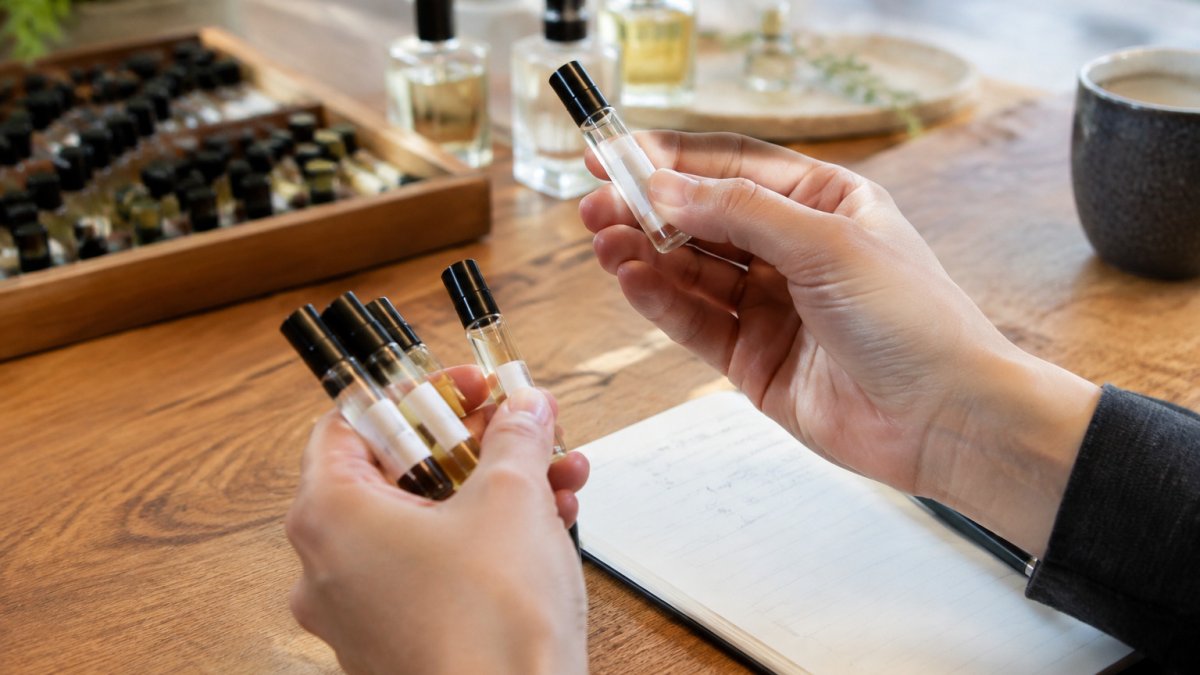
Step 1: Start with a discovery set or a small decant order
A decant is a portion of a full bottle transferred into a smaller sprayer, and it lets you test a specific fragrance you cannot find in a store.
Order two or three scents from different categories, such as one niche and one designer, so you are comparing styles rather than just brands. Our decant buyer's guide covers how to choose by size, concentration, and seller authenticity.
Step 2: Test on skin, not on paper
Spray each fragrance on skin, not on a paper strip, and wear it for a full day. Apply to one wrist and the inner forearm so you can smell it up close without broadcasting it to everyone around you.
Watch out: testing more than one fragrance on the same day makes it hard to tell which one is fading and which one is still projecting. Space tests at least a day apart, and avoid wearing other fragrances or heavily scented lotions on test days.
Step 3: Test in the conditions you actually wear fragrance
A fragrance tested in a climate-controlled store on a cool afternoon tells you little about how it will perform at a summer outdoor event or in a dry office. Test at least once in the environment where you plan to wear it, and test once on a day when you are moving around rather than sitting still. Heat, humidity, and activity level all change projection and longevity.
Step 4: Check the return policy before you buy a full bottle
Return policies for fragrance vary widely. Some retailers accept opened bottles within a set window; many do not accept opened fragrance at all for hygiene reasons. Read the policy before checkout.
Step 5: Buy the full bottle only after a scent passes the test
Buy the smallest full bottle available first; you can always size up once you know you will finish it.
If you are not sure where to begin, a focused sample set is often the cheapest way to find a signature fragrance. Our concierge service can help you narrow your choices based on the scents you already like.
Frequently Asked Questions
Are niche fragrances better than mainstream perfumes?
Not automatically. Niche houses usually use smaller distribution, more unusual accords and perfumers who work with more creative freedom, which many wearers find more distinctive. Mainstream designer scents are built for broader appeal, are easier to find in department stores and often cost less per milliliter. Better depends on what you want from a fragrance: originality and exclusivity favor niche, while availability and a familiar, widely recognized scent favor mainstream. Sampling both before committing to a full bottle is the most reliable way to decide.
Are niche perfumes more long-lasting than mainstream perfumes?
Not reliably. Longevity depends mainly on concentration (eau de parfum versus eau de toilette), the ingredients in the formula, your skin chemistry and how you apply it. Some niche fragrances are very long-lasting and some mainstream ones fade quickly, so price is not a dependable guide. Compare the concentration printed on the bottle and test on your own skin, since a decant lets you check how a scent performs over a full day before buying the full size.
Why are niche perfumes usually more expensive?
Niche houses typically produce in smaller batches, spend more on raw materials and rely less on large advertising budgets, so their costs per bottle are higher. Many niche brands also sell through fewer channels, which means less volume to spread fixed costs across. Olfactory Outlaws offers decants from $5.00 to $25.00, so you can explore a niche scent before paying for a full bottle. The Monthly Bounty Box is $35.00 and includes one premium 10ml decant plus two premium samples.
Is Dior considered a niche perfume?
Dior is generally classed as a designer or mainstream fragrance house rather than a niche one. It has wide distribution through department stores and a large advertising presence, which are the traits that separate designer lines from independent niche houses. Some Dior releases use more unusual compositions, so a single product can sit closer to the niche end of the spectrum even when the brand does not. Comparing a specific scent's notes and availability is more useful than relying on the brand label alone.
